



The Time to Trade Tokenized Assets Is Now
The Time to Trade Tokenized Assets Is Now
Getting access to traditional financial markets (TradFi) — stocks, indices, commodities, metals — used to require a brokerage account, a lengthy verification process, and strict adherence to exchange trading hours. Veles removes those barriers entirely: Tesla, Nvidia, gold, oil — all of it trades through Veles bots from a single interface, right alongside automated crypto bot review. No need to choose one world over the other.
The timing is compelling, and the market data backs it up: in Q1 2026 alone, the trading volume of tokenized asset futures reached $524.8 billion — more than the entire volume recorded throughout all of 2026.
Major research teams, including BCG, project this sector could grow to $10–30 trillion within a decade. Entering now means positioning at the very start of that trend — while liquidity and the number of available instruments are still expanding.
Where the Momentum Is Right Now
Three key factors are generating clear trading opportunities over the coming months.
Geopolitics has put oil in motion. The ongoing Middle East conflict and threats to shipping lanes have kept Brent hovering around $100 per barrel — roughly $30 higher than a year ago — with prices spiking to $125 at peak escalation. As long as regional tensions persist, this real-demand asset continues to offer tradeable volatility.
Gold is printing historic highs. In early 2026, an ounce crossed $5,500, before pulling back as the dollar strengthened and Fed rate expectations shifted. Structural buying from central banks provides a durable price floor — a factor that isn't going anywhere over the next quarter. The pullback into range creates a two-sided trading opportunity.
Institutional capital is entering tokenized assets early.
Chainalysis analysts are recording a surge in wallets created specifically to hold tokenized instruments. As more participants and liquidity flow into the market, price action becomes cleaner and more predictable — exactly the conditions that make systematic strategies work.Why Tokenized Assets Are Ideal for Bot Trading
- Fundamentally driven price action. Commodities respond predictably to geopolitical shifts, gold reacts to rate policy, stocks move on earnings. These consistent relationships are exactly what Veles experts encode into bot logic. Trading an asset anchored to real demand and identifiable catalysts is far more systematic than chasing sentiment-driven moves.
- 24/7 trading with no session gaps. Tokenized stocks and commodities trade around the clock — no exchange hours to work around. A bot captures moves whenever they happen, including reactions to overnight news that traditional markets would miss entirely.
- Low minimum capital required. Assets are divisible into fractional units, so strategies can be launched with a modest deposit, tested live, and spread across multiple instruments — without tying up significant capital in a single position.
TradFi Bots: Automated Trading Without Becoming an Asset Specialist
Here is how it works. You create an exchange account and connect it to the Veles platform via API. The bot receives the API keys and trades your chosen asset according to a defined strategy. Every trade is visible in real time, and you retain full control over access at all times. You can build a custom bot from scratch, but the faster and more reliable path is to use a ready-made strategy — developed by Veles experts and backtested against historical data for each specific instrument.
For the current market environment, the Veles team has prepared strategies across four asset categories.
| Asset Class | Copy Settings | PnL | MDD | Max. Time in Trade |
|---|---|---|---|---|
| Commodities | BRENTOIL HYPERLIQUID LONG BOT | 11.49% | -10.36% | 7 days |
| WTIOIL LONG HYPERLIQUID BOT | 19.81% | -25.68% | 21 days | |
| Stocks | NVDA LONG HYPERLIQUID BOT | 7.92% | -6.44% | 6 days |
| MSFT LONG HYPERLIQUID BOT | 3.99% | -6.21% | 27 days | |
GOOGLE HYPERLIQUID BOT | 3.06% | -8.69% | 39 days | |
| Precious Metals | [BINANCE] SILVER TREND BOT | 15.97% | -19.61% | 18 days |
| [BINANCE] XPD CCI SELECTIVE BOT | 12.87% | -17.88% | 13 days | |
| [BYBIT] XAUT GOLD BOT | 10.3% | -10.45% | 22 days | |
| Pre-IPO | SPACEX HYPERLIQUID BOT | 4.1% | -5.43% | 1 day |

1. Commodity Trading Bots
BRENTOIL HYPERLIQUID LONG BOT
A bot built for trading wrapped Brent crude. It opens a position when price reaches a high-volume zone during an active correction. The strategy uses a four-order grid with a 15% overlap. Profit is taken in two stages — at 1% and 2%. Once the first take-profit is hit, the stop-loss is moved to breakeven automatically.
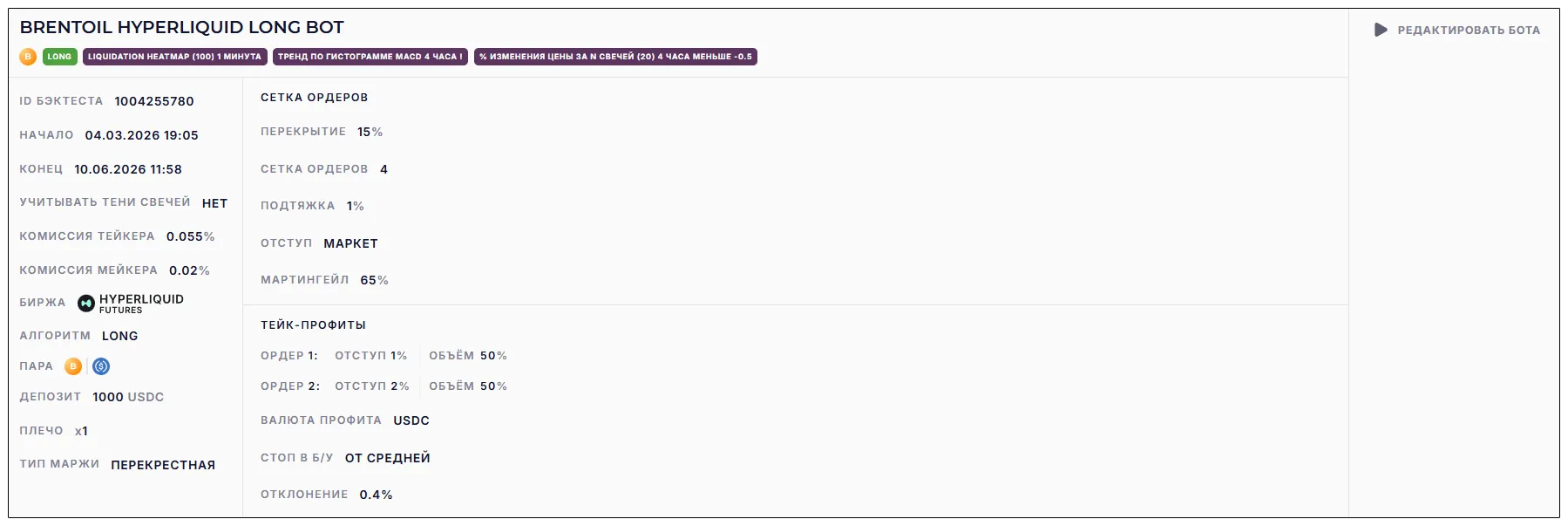
- MDD: -10.36%
- Deposit: 1000 USDT
- Net PnL: 11.49%
WTIOIL LONG HYPERLIQUID BOT
A high-frequency bot for trading wrapped WTI crude. It enters a position when volatility spikes within an overbought zone, with additional filtering based on buyer activity. Each of the three subsequent averaging orders requires its own confirming signal of the same type. Profit is locked in via a short take-profit once the overbought zone is reached again.
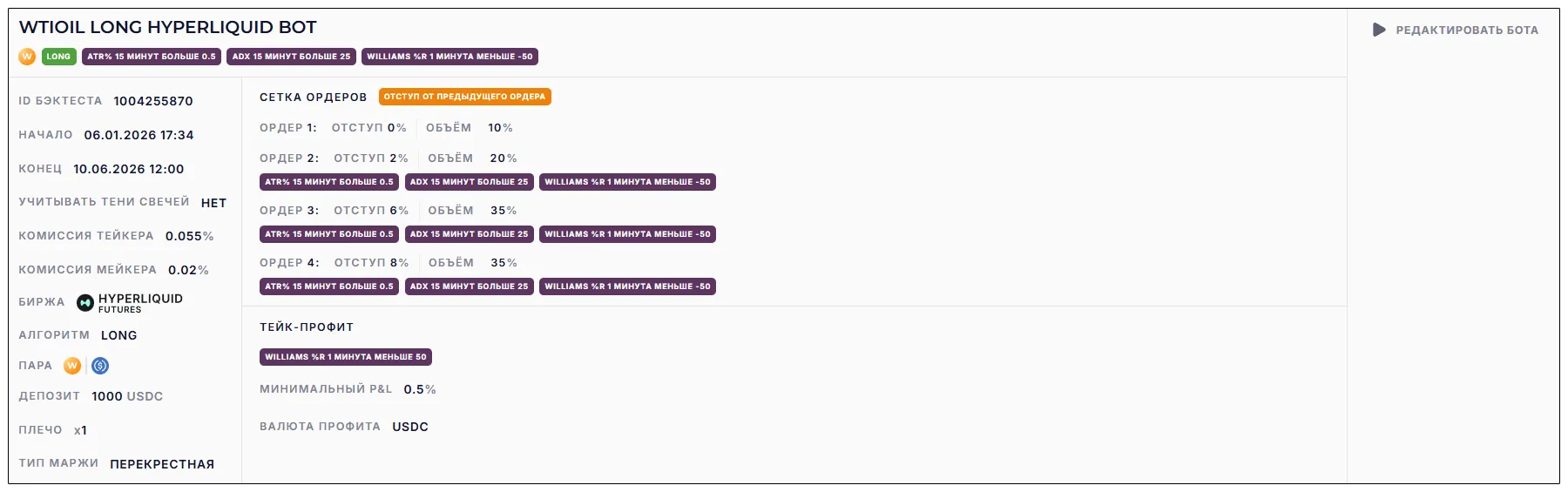
- MDD: -25.68%
- Deposit: 1000 USDT
- Net PnL: 19.81%
2. Bots for Large-Cap Stocks
NVDA LONG HYPERLIQUID BOT

A dynamic grid bot. It enters when oversold conditions develop within a broader downtrend on the higher timeframe, with additional confirmation from local divergence. Each of the three averaging orders is triggered by its own reinforcing signal backed by volume analysis. The exit is a short take-profit, also volume-confirmed.
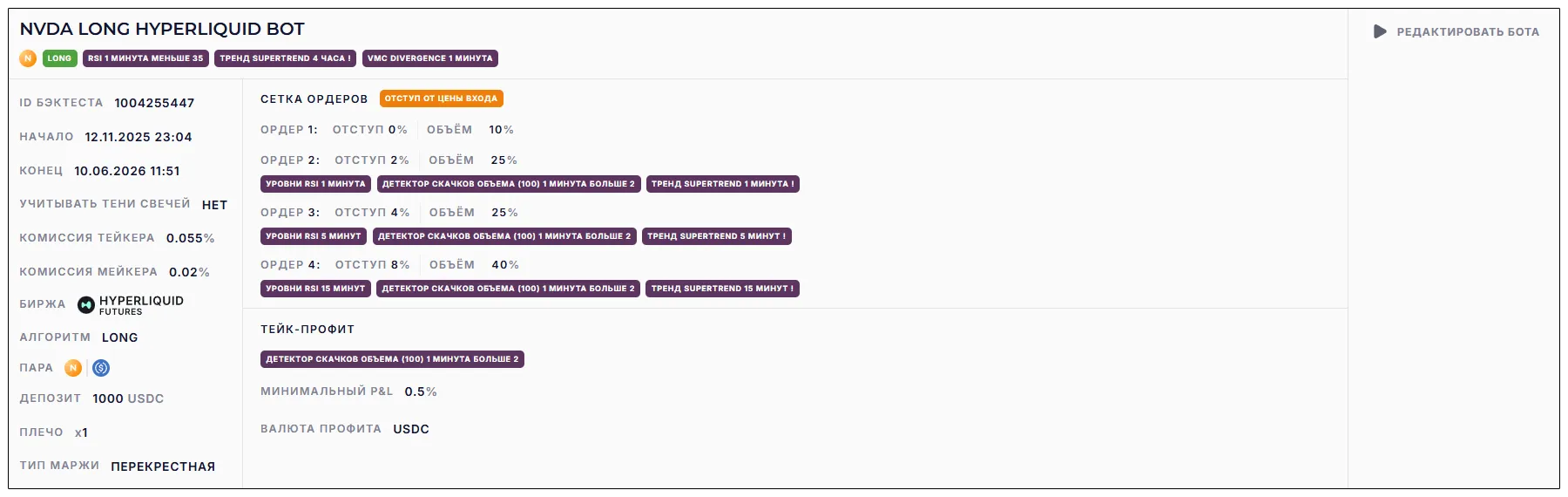
- MDD: -6.44%
- Deposit: 1000 USDT
- Net PnL: 7.92%
MSFT LONG HYPERLIQUID BOT
A volatility and mean-reversion strategy. The bot opens a position when price tags the lower boundary of a defined price channel. If the downward move continues, it adds three more orders to the position. The trade is closed when price returns to the upper boundary of the channel.
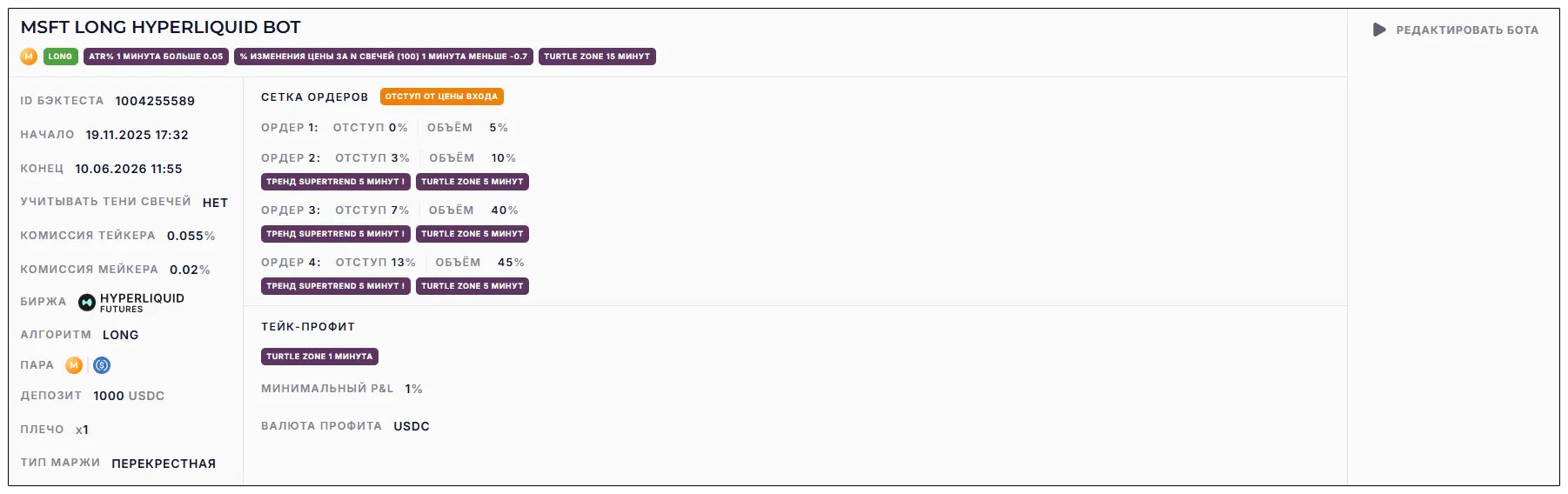
- MDD: -6.21%
- Deposit: 1000 USDT
- Net PnL: 3.99%
GOOGLE HYPERLIQUID BOT
A bounce-catching bot designed for post-correction recoveries. It enters when a likely price reversal is forming. Four averaging orders each require their own counter-directional confirming signal. Profit is taken at a classic 1% take-profit level.
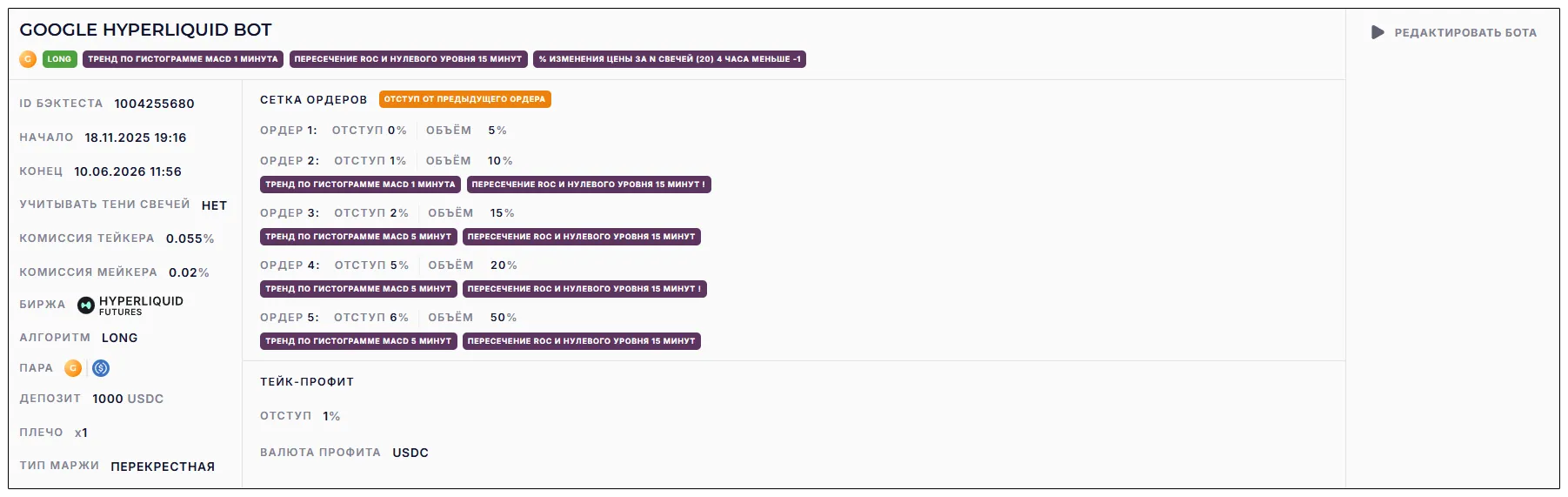
- MDD: -8.69%
- Deposit: 1000 USDT
- Net PnL: 3.06%
3. Precious Metals Bots
[BINANCE] SILVER TREND BOT
A high-frequency bot for trading wrapped silver. Best suited to steady uptrends — not designed for corrective phases.
![[BINANCE] SILVER TREND BOT settings](https://veles.finance/_astro/bot-silver.B2BXCOna_Z2maRz2.webp)
- MDD: -19.61%
- Deposit: 1000 USDT
- Net PnL: 15.97%

[BINANCE] XPD CCI SELECTIVE BOT
A high-frequency bot for trading wrapped palladium. Performs best during gradual downtrends and sideways consolidation — these are the market conditions it is specifically calibrated for.
![[BINANCE] XPD CCI SELECTIVE BOT settings](https://veles.finance/_astro/bot-xpd.Um35yzGE_ZJqWkW.webp)
- MDD: -17.88%
- Deposit: 1000 USDT
- Net PnL: 12.87%
[BYBIT] XAUT GOLD BOT
A high-frequency bot for trading wrapped gold. Delivers its best results during smooth upward trends — not recommended for sharp corrective moves.
![[BYBIT] XAUT GOLD BOT settings](https://veles.finance/_astro/bot-xaut.BYBzZGXo_ZBKxTc.webp)
- MDD: -10.45%
- Deposit: 1000 USDT
- Net PnL: 10.3%
4. Pre-IPO Bot
SPACEX HYPERLIQUID BOT
A strategy built around trading the implied valuation of SpaceX (pre-IPO). Entries are triggered at key local price levels, with volatility expansion evaluated against the higher-timeframe corrective context. Dynamic reinforcing orders are used for position averaging. Profit is captured through short take-profits adjusted for the prevailing trend direction.
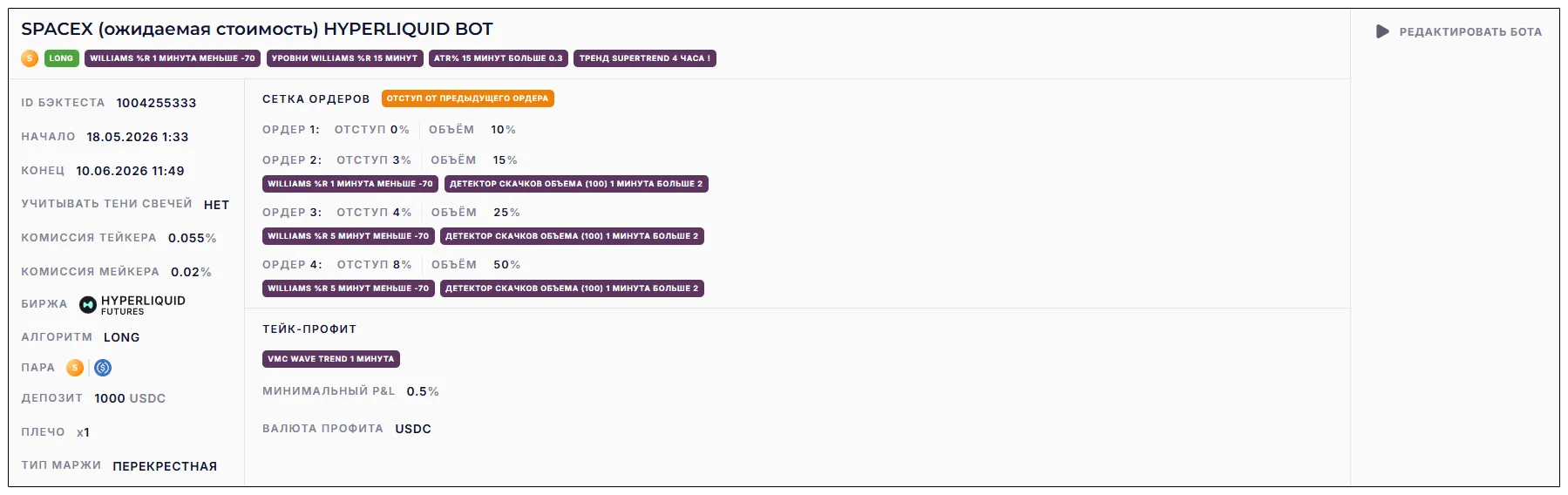
- MDD: -5.43%
- Deposit: 1000 USDT
- Net PnL: 4.1%

The Bottom Line
Sitting out a fear cycle in automated crypto bot review means leaving your capital idle while real movement is happening elsewhere. Oil, gold, equities, and pre-IPO assets run on their own catalysts — completely independent of Bitcoin sentiment. Tokenized market volumes are already substantial enough to trade seriously, and the market itself is only getting started. Bots eliminate the barrier to entry: you do not need to become an oil analyst or a metals specialist to trade them.