



They made history
They made history
The history of Uzbekistan lasts longer than one millennium. The area between the Amudarya and Syrdarya rivers was inhabited by ancient people in the early Paleolithic. Years and centuries passed away, the cities grew and civilizations developed, which today are rightly considered to be the most ancient in the East. For centuries, there were heroes and scientists, thinkers and poets among the people – the people who created the history of our region and praised it for the whole world.
ABU ALI IBN SINA

Abu Ali Ibn Sina is known around the world as the founder of modern medicine. His works in this area are appreciated all over the world to this day. He has made significant contribution also to science and philosophy. For 57 years of his life, he wrote more than 450 works in 29 fields of science.
Ibn Sina, or Avicenna, as he was known in Europe, was born in 980 in the village of Afshan, near Bukhara. He began to show his genius at a young age – at the age of 10 he knew the Koran by heart, but at 20 he began to provide treatment to people. The treatment method, which was unusual for that time, allowed him to cure seriously ill people, for which he was called “Prince of Physicians”.
The life of Abu Ali Ibn Sina was not smooth and comfortable – wandering alternated his prosperous life often. He was also an archiater and adviser to the rulers, and sometimes he was imprisoned because of the change of power.
Avicenna wrote his numerous scientific works in all circumstances, we can say he could not live without writing The knowledge that filled him, flowed to thousands of paper pages. Among the most important of his works are “The Book of Knowledge”, “The Book of Healing”, “The Book of Medication”, “The Canon of Medicine” (5 books), the latter is considered one of the most famous books in the history of medicine. Along with this Ibn Sina wrote collections of poetry and theological treatise.
Avicenna died in 1037, leaving behind a huge legacy, which is still being used by his descendants today.
ABU RAYHAN BIRUNI

Biruni is called a polymath, and this is quite true. He wrote works on mathematics, astronomy, physics, botany, geography, general geology, mineralogy, ethnography, history, chronology, and others.
Historians have often referred to the first half of the XI century as the “Age of Biruni” in science. They say that a posthumous list of his works, compiled by students, took 60 closely written pages. Among his major works we can state “The Canon of Mas’ud in astronomy and the stars”, “Pharmacognosy in Medicine”, “India, or book, containing an explanation of Indian teachings, which are accepted by reason or rejected”, “The Science of Stars” and others.
Abu Rayhan Muhammad Ahmad al-Biruni was born in 973 in the town of Kyat (the capital of the Khorezm). He was an orphan. Being a well-known scientist he worked at the court of the Khorezm Shah, but was later forced to move to Qabas. Biruni died in the town of Ghazni in 1048.
Today, there is a city in Uzbekistan called Biruni, there is also a Tashkent University named after Abu Rayhan Biruni. The name of the great scientist, a genius of his time, is revered everywhere, his works are studied and used in various fields of science.
ALISHER NAVOI
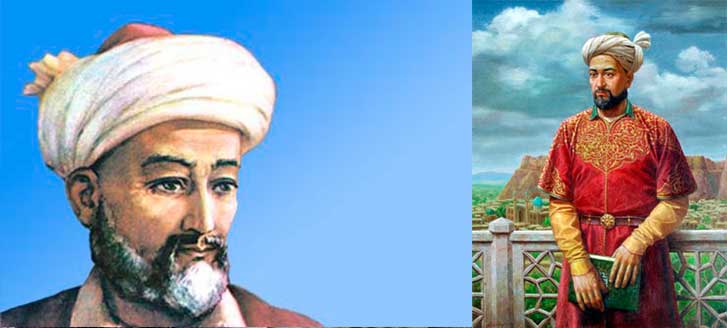
“People can not be alive forever, but happy is he whose name will be remembered.”
The author of these lines is Alisher Navoi, he wrote it very much about himself, because his memory will live forever. The great philosopher and poet, was born in 1441 in Herat. The house in which Nizamaddin Mir Alisher grew, who later took the pseudonym Navoi (songful), was visited by prominent philosophical thought and art leaders of the time.
His father Giyaseddin Kichkina was an officer in the Timurid State, for this reason his son Alisher was brought up with the children of Timurid families. A strong friendship bound Navoi with Sultan Hussein Baykara, who later became his patron and collaborator.
Creativity of Alisher Navoi showed up quite early. By the age of 15 he was already known as a poet. Navoi wrote his poems equally well in the Chagatai and in Farsi languages.
Alisher Navoi got his education in Herat and Samarkand. In 1469 he was appointed as Keeper of the Seals by Sultan and his friend Hussein Baykara. Along with his political activities, Navoi paid special attention to creativity. The legacy that he left to his descendants, is huge and is manyfold.
One of his major works is “Khamsa”, on which Navoi worked in 1483-85. The work includes five epic poems – “Confusion of the righteous” (1483), “Layla and Majnun” (1484), “Farhad and Shirin” (1484), “Seven Planets” (1484), ” Wall of Iskander “(1485).
Alisher Navoi created 30 books of poetry, major poems, essays and scientific treatises. His works are included in a modern educational system of Uzbekistan. He was imitated by many followers, his work opened the whole poetic direction. Today in Uzbekistan the National Library is named after Alisher Navoi and also the Opera and Ballet Theatre, both located in the center of Tashkent. One of the metro stations, which has the name of this great poet, is decorated with panels of scenes of “Khamsa” and with a bas-relief of Navoi. The guests of the capital certainly try to visit these places, which are unique architectural monuments.
AL-KHWARIZMI

The founder of the classical algebra Abu Abdullah Muhammad ibn Musa al-Khwarizmi was born in Khiva at the end of the VIII century. The exact date of his birth is unknown, but theoretically it is 783. Also, nothing is known about his childhood. In some sources he is called “al-Majusi”, the magician, which implies that he originates from a sort of Zoroastrian priests, which later converted to Islam.
In all sources this scientist is called the father of algebra. We can not say that it did not exist before him. Even in ancient times people solved simple algebraic problems, but al-Khwarizmi made algebra an independent science about the general solution methods of numerical linear and quadratic equations.
It should be noted that the term “algebra” is derived from the word “Al Jabr”, which is taken form the al-Khwarizmi’s treatise “Al Jabr Hisab val Muqabala ” (“Method of Completion and Balancing”). But “algorithm” (the general solution of any mathematical problem) is derived from the name of the scientist, so the algorithm is a corruption of the name al-Khwarizmi.
Like many Central Asian scholars, Al-Khwarizmi was invited to the “House of Wisdom” in Baghdad, where the greatest scientists of those years worked .
The scientific heritage of al-Khwarizmi was almost twenty books, of which no more than ten survived . The most popular books are – “The Book of Completion and Balancing” and the “Astronomical tables”. Many generations of scholars, both in the East and in the West used the tables of al-Khwarizmi.
AMIR TEMUR

The significance of this figure has a special status in Uzbekistan. Amir Temur, who was known in Europe as Tamerlan, is considered a national hero and a legend.
The future Mawarannahr’s (Transoxiana) liberator from foreign invaders, was born in 1336 in the village of Khodja-Ilgar (modern city Shahrisabz). Temur ibn Barlas Taragay (son of Timur Taragay of Barlases) is the full name of the “Iron” commander. His name Temur comes from Turkic language and means “iron”. Many historians describe his character as an iron-willed. Amir Temur was a brave and courageous. In one of the trips he was wounded in the leg, causing noticeable limp, but it only gave him a frightening appearance. It is known that Temur had athletic build, his height was 172 cm (it became known after the opening of his tomb), he was strong much more than any of his soldiers, and always personally involved in all the campaigns.
By the beginning of the XV century, Temur has created one of the greatest empires in history. Samarkand, which Temur made his capital, has become the largest and richest city in the East. To protect their land – from the river Volga and Caucasus mountain in the west to India in the Southwest – he created an almost perfect army. During the reign of Amir Temur large-scale construction was carried out in Samarkand and other cities, in which monumental buildings were erected, body of law and art developed.
Today, in honor of the great commander in the center of Tashkent, the square has his name, with a majestic monument – Amir Temur seated on a horse with his hand raised, across the street from it there is a museum of Timurids. Monument of Amir Temur is depicted on the Uzbek banknote of 500 soums, and in 1996 the Order of the “Amir Temur” was established.
ZAKHIRIDDIN MUHAMMAD BABUR
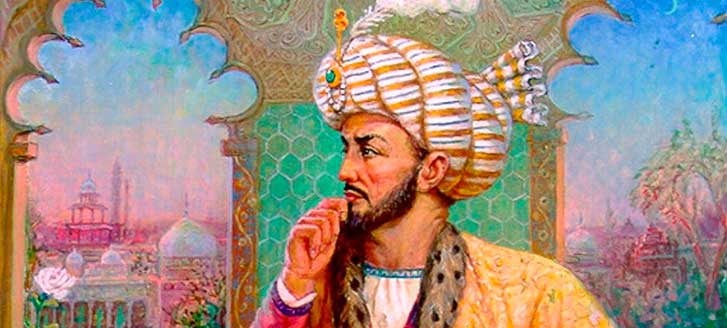
On February 14 the Birthday of Babur – statesman, military leader and writer is widely celebrated in Uzbekistan. Zakhiriddin Muhammad Babur left a deep imprint on the political and literary life of Maverannahr in the XV-XVI centuries. He was born in 1483 in Andijan in the family of Fergana Emir Umar Sheikh Mirza II, great-grandson of the Timurid sultan Miran Shah, the third son of Amir Temur.
Babur came to power early, at age 11, he was declared the ruler of Fergana. However, only 10 years later, in 1504, he was forced to leave their land and move to Kabul, where he created a new state. Until 1526 he repeatedly tried to regain their land, but to no avail. During this period, his attention gradually switched towards India, which he conquered in 1526. It was his last war trophy. In India, he founded the empire of Babur and the Mughal, which existed 300 years.
Babur died on Dec. 26, 1530 in Agra, but his remains were transported to Kabul.
Along with the huge public affairs, Babur left a very valuable literary heritage. The main work of his life – an autobiography “Babur-name”. The book describes traditions and customs of people of that time.
Source : www.welcomeuzbekistan.uz